Home / Echo in Hard Surface Rooms
Echo in Hard Surface Rooms
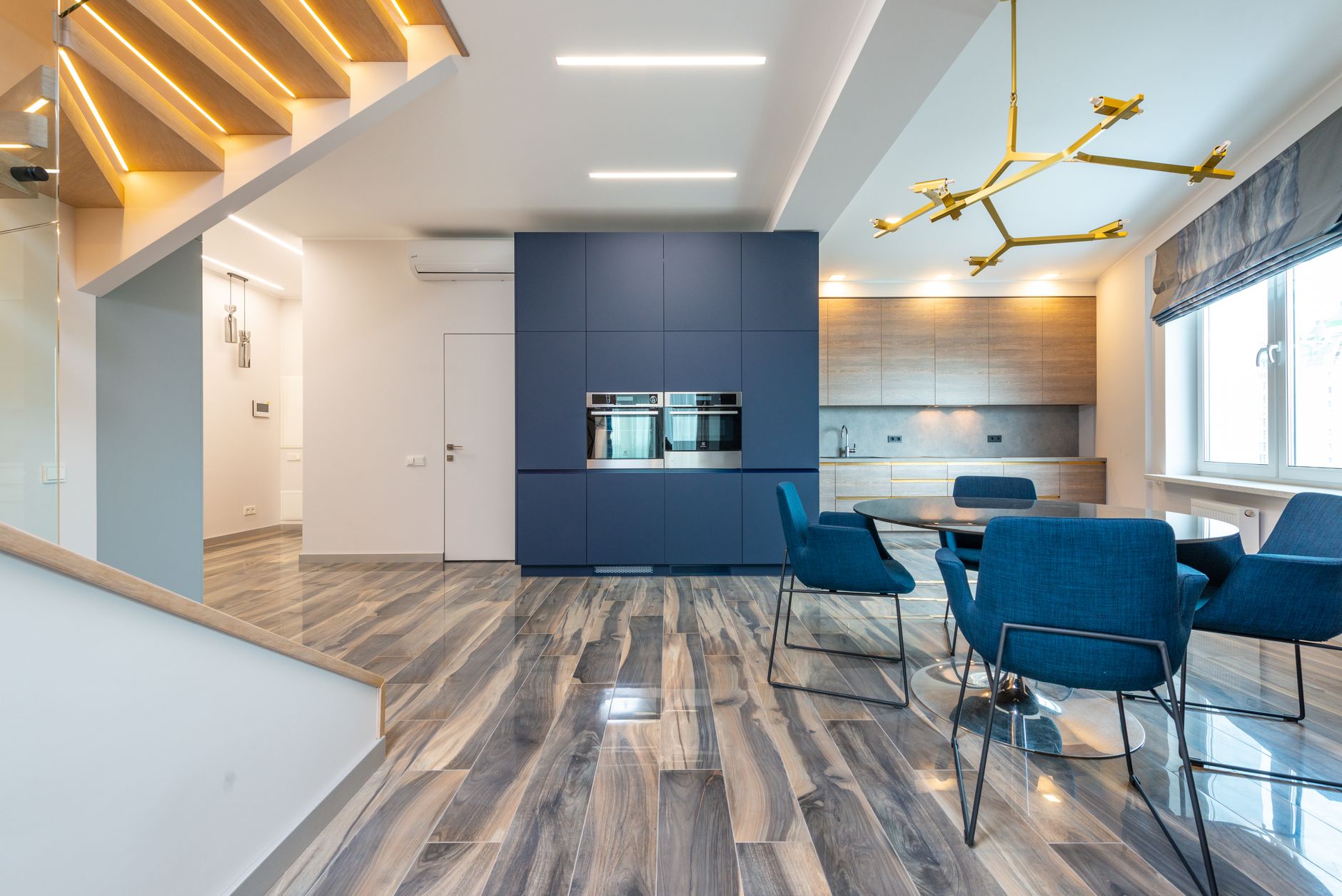
Clap once in an empty room and listen. If the sound lingers and rings back at you, the room has a long reverberation time. Furnish the same room with sofas, curtains and rugs, and the clap dies almost at once. The difference is absorption, and understanding it explains why bare floors make rooms echo and what actually softens them.
How sound bounces
Sound spreads from a source in every direction as a pressure wave. When it hits a surface, some energy is absorbed, some passes through and the rest reflects. Hard, dense, smooth surfaces such as concrete, tile, glass and plaster reflect nearly all of it. In a room made entirely of those materials, a sound can bounce between walls, ceiling and floor many times before it fades. Each bounce arrives a fraction of a second after the last, which the ear hears as echo or reverb, and it smears speech into mush.
Echo versus reverberation
True echo is a distinct repeat, heard in large halls or canyons where the reflection arrives more than a tenth of a second after the original. Most homes produce reverberation, a dense wash of overlapping reflections too quick to separate. The practical effect is similar: voices lose clarity, television dialogue becomes hard to follow, and conversations require raised voices, which makes the room louder still. The measure acousticians use is the time it takes sound to fade by a large amount, called reverberation time. A living room that feels comfortable has a short one. A bare garage conversion has a long one.
Where the floor fits
The floor is one of the largest surfaces in a room, and replacing carpet with a hard finish removes a major absorber. The ceiling and walls matter just as much, though. A hard floor beneath a hard ceiling with bare parallel walls creates the worst case. Strip away furniture and the problem multiplies. If a room echoes, the culprit is almost never the floor alone, but the floor often tips it over the edge.
What absorbs sound
Absorbers are soft, porous or fibrous materials that convert sound energy into tiny amounts of heat as air moves through them. The best ones for homes:
- Thick curtains. Heavy fabric hung with some fullness over windows and glass doors.
- Area rugs on dense pads. The pad is important because it adds depth.
- Upholstered furniture. Sofas and armchairs are large, soft and strategically placed.
- Bookshelves filled with books. Uneven surfaces scatter sound, as well as absorb some of it.
- Acoustic panels. Fabric wrapped fiberglass or mineral wool boards that hang on walls or ceilings.
- Plants. Their effect is small, but they scatter high frequencies.
Where to put things
Placement multiplies the effect. Treat the first reflection points, where sound from the speaker or the seating area bounces off a side wall on the way to the listener. A panel or bookcase at those spots helps clarity. A rug between the seating and the television, where sound crosses the floor, cuts the floor bounce. Hang something absorbent on the wall opposite the loudest source. Avoid putting all the soft material in one corner; distribute it so every wall and the ceiling get some.
Ceilings: the forgotten surface
Many rooms have untreated flat ceilings that reflect sound straight back down. Acoustic ceiling tiles, a suspended cloud panel above the seating area or even a fabric canopy reduces reverberation. In a room with a high ceiling, the effect is larger. If options are limited, adding absorbers at the ceiling above the area where people talk is often more effective than adding more floor covering.
Breaking up flat surfaces
Absorption is not the only answer. Diffusion scatters sound in many directions, so it no longer returns in a concentrated flash. Irregular surfaces diffuse: a bookshelf with items at different depths, a textured wall, a coffered ceiling, furniture with curves. A room that has a mix of absorption and diffusion sounds natural, not dead. Overdoing absorption can make a space feel muffled, so aim for balance.
Quick tests
A clap test is a simple check. Stand at the center of the room and clap sharply. A short, dry pop means decent acoustics. A fluttering ring that hangs in the air means reflections are bouncing between parallel surfaces. Move around the room and clap in different places to find where it is worst. Phone apps that estimate reverberation time are available and give rough numbers, which are good enough to compare before and after changes.
Speech, music and television
Different sounds need different cures. Speech lives in the middle frequencies, and a handful of soft furnishings clears it up well. Music has deep bass that thick curtains barely touch; bass is tamed by bulky absorbers such as thick panels placed in corners, where low frequency energy gathers. Television dialogue suffers from reflections off the screen wall and the floor in front of it, so a rug in front of the set and soft material beside it often does more for clarity than turning up the volume. When people keep reaching for the remote to raise the volume, it is usually a sign that the room is smearing the dialogue, not that the speakers are too quiet.
Noise to other rooms
Echo is about sound inside the room; transmission is about sound escaping. Absorbers inside a room do little to stop sound passing through walls. For that, mass, sealing and decoupling are the tools, such as heavier drywall, sealed gaps around doors and insulation inside walls. If a hard surface entertainment room is disturbing the house, both problems may need attention, but start with the interior since it improves the experience of everyone in the room immediately.
Starting small
Begin with the cheapest changes. Put a large rug with a thick pad under the main seating group. Hang curtains over any bare windows. Add a bookcase or a padded piece of furniture on the longest wall. Test again. Most rooms improve substantially after those three steps, and the remaining fixes, panels and ceiling treatments, can be added only if the room still rings.